Quantified Midterm Theory (QMT) demonstrates that midterm outcomes are not chaotic political events, but the result of a stable, quantifiable field driven by measurable indicators. The model’s performance across 56 years suggests that national mood behaves like a physical system: deviations in approval, independent sentiment, economic conditions, and consumer psychology combine linearly into a composite that maps cleanly onto historical midterm outcomes. The full theory is linked above, and we welcome it’s peer testing. The falsifiable proof is in the upcoming midterms of November 2026.

With Mathematical Formula
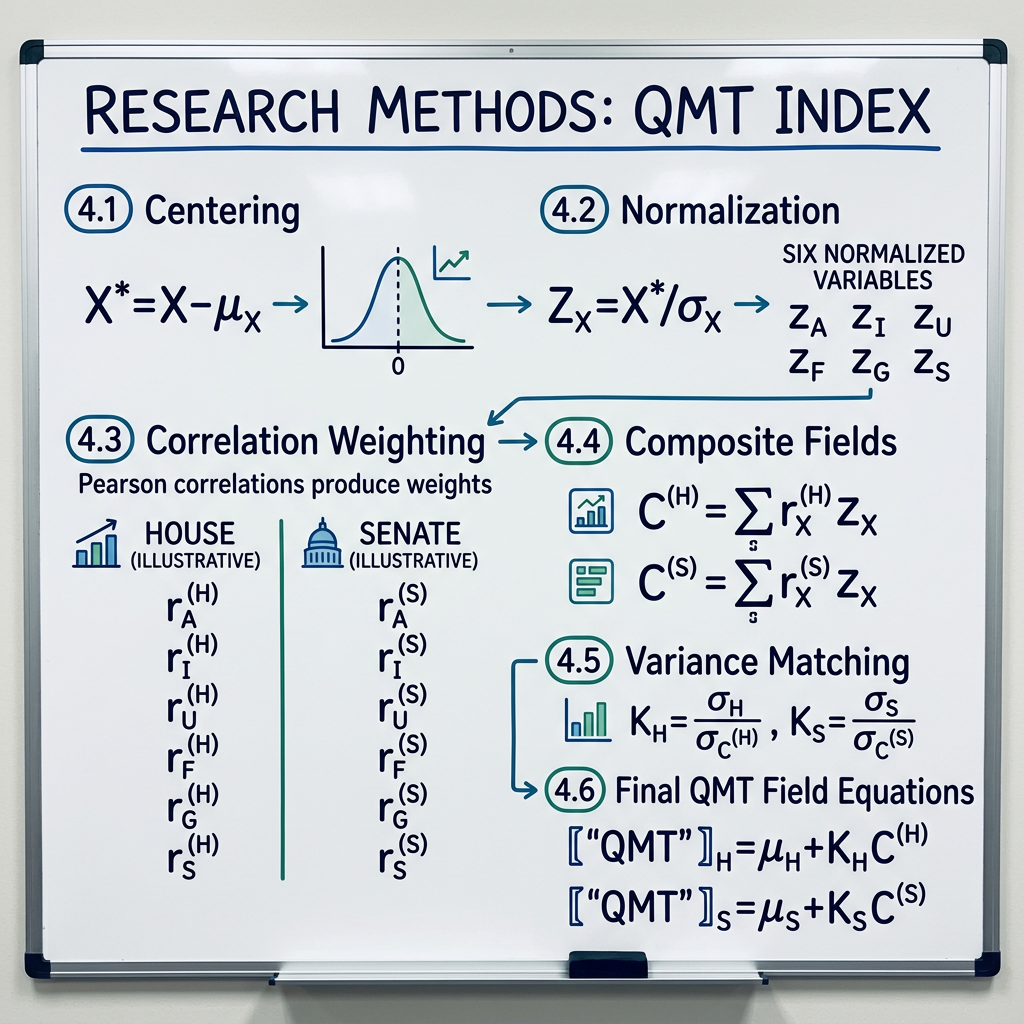
The 2026 midterm Falsification Test:
QMT is falsified if:
The real-world House outcome falls substantially outside the historical variance band implied by a field pressure of –36, or
The real-world Senate outcome falls substantially outside the historical variance band implied by a field pressure of –5.
What QMT Found (sans the math)
Across 56 years (1966–2022), midterm outcomes follow a stable, measurable pattern. When approval drops, independents sour, unemployment rises, inflation spikes, growth slows, or sentiment collapses, these forces combine into a single composite that reliably pushes midterm results negative.
When conditions improve, the composite moves positive. This is the key insight:
QMT demonstrates that midterm outcomes are not chaotic political events, but the result of a stable, quantifiable field driven by measurable indicators. The model’s performance across 56 years suggests that national mood behaves like a physical system: deviations in approval, independent sentiment, economic conditions, and consumer psychology combine linearly into a composite that maps cleanly onto historical midterm outcomes.
In other words, refreshingly: Midterms behave like physics. The QMT scientific formula does not predict future elections; it describes the structure of midterms using historical data. It shows:
Why midterms behave consistently
How national mood translates into seat changes
Which indicators matter and how much
How the composite filed behaves across cycles.
How QMT Is Falsifiable: Is It Scientific
QMT is a scientific model because it can be proven wrong.
QMT is falsified if:
A future midterm result falls far outside the historical variance band implied by the field value
Future correlations diverge significantly from the historical matrices
Normalization baselines become unstable
This makes QMT fully testable:
You insert today’s indicators into the equation, compute the field pressure, and compare it to the real midterm outcome.
If the outcome doesn’t match the structural band, QMT fails — exactly what a scientific model must allow.